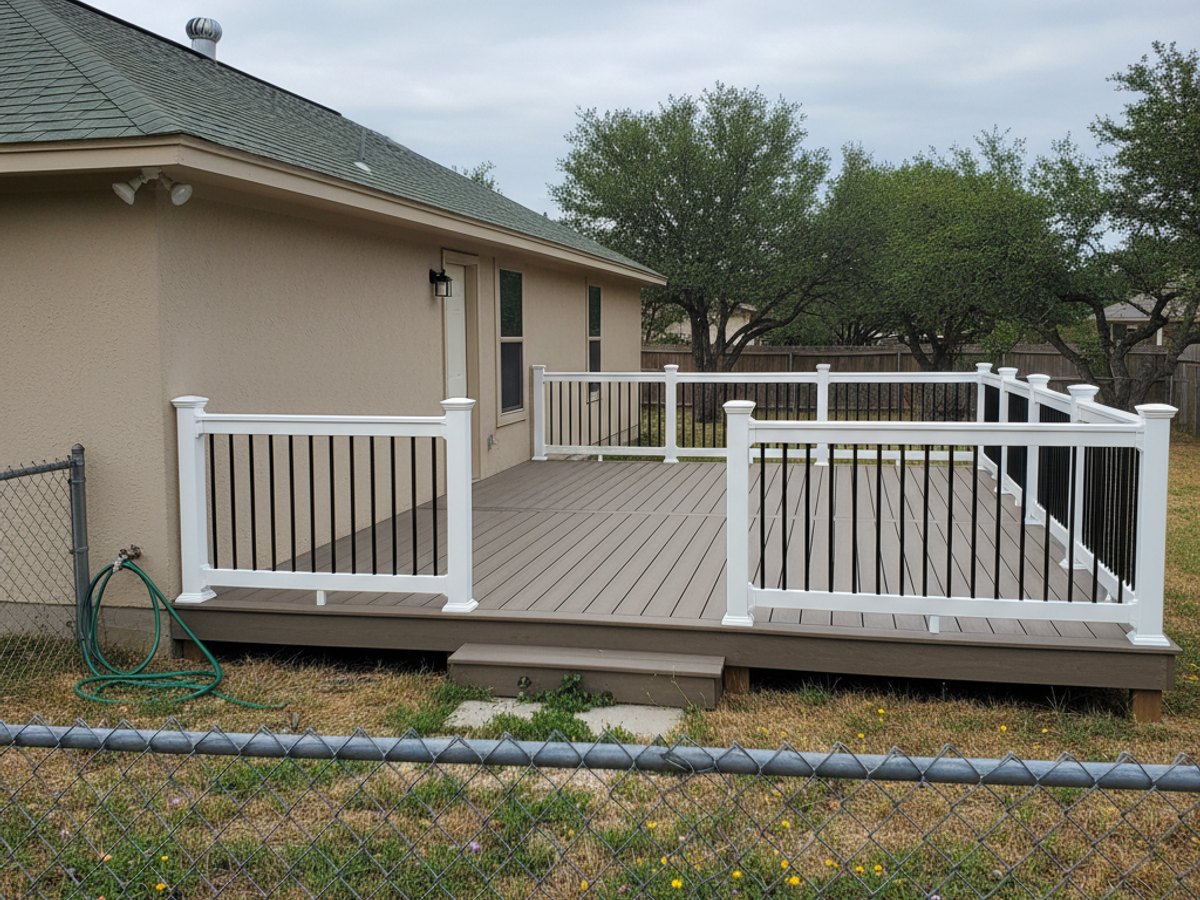
Most people shopping for a deck builder in Edinburg end up comparing three quotes that look nothing alike. One guy is $4,000 cheaper. One shows up with a tablet and a rendering. One just talks. None of that tells you who's actually going to build something that survives a Valley summer and a wet September. Here's what actually matters.
What our soil does to a deck's footings
Edinburg sits on a mix of clay and caliche, that chalky, compacted layer that can be nearly impossible to dig through dry and turns slick and soft after a heavy rain. A lot of builders treat footings the same way everywhere in Texas, but caliche changes the math. If someone hits rock-hard caliche two feet down and just stops the hole there because the auger won't go further, that's not a design decision, that's giving up. A post footing needs enough depth and enough concrete bell at the bottom to resist the clay swelling around it when the ground gets wet. Around here that usually means digging to 24 to 30 inches for a ledger-attached deck carrying real load, not the 12-inch minimum some crews use to save an hour of digging.
Ask how they're setting posts. Sonotube forms with a poured concrete pier, tied down with a post base bracket, is the standard for a reason. If a builder tells you they just set the post directly in a dug hole and backfill with dirt, that's a deck that will lean within a couple of years once the clay starts moving with the wet-dry cycle we get every year.
Framing and hardware, not just the decking on top
Homeowners judge a deck by what they can see, the boards. But the part that actually fails is underneath. Joists at 16 inches on center for standard 5/4 decking, 12 inches for some composite spans, hot-dip galvanized or stainless hardware because our humidity eats standard zinc coating over time, and a properly flashed ledger board bolted with lag screws or through-bolts into the house rim joist, not just nailed. A ledger that isn't flashed is how water gets behind your siding and rots the band joist from the inside, and you won't see it until the deck starts to pull away from the house.
If a contractor's quote doesn't mention joist hanger type, ledger flashing, or footing depth, ask. If they get vague, that tells you something.
What the climate does after the deck is built
We get long stretches over 95 degrees from May through September, and that heat cures composite decking differently than it cures pressure-treated pine. Composite boards need real gap spacing, usually 1/8 to 3/16 inch between boards depending on the manufacturer, because they expand in the heat more than wood does. Skip that gap and you get buckling by the second summer.
Pressure-treated pine needs to dry out before you stain or seal it, sometimes 60 to 90 days depending on how wet it was when it was installed. A builder who tries to seal it the week it's built is doing it because it looks finished faster, not because it's right. And hurricane season runs June through November here. A covered deck or pergola needs its posts and beam connections rated for wind uplift, not just gravity load. Ledger straps and hurricane clips aren't optional extras on an attached structure.
Permits and inspections in Edinburg
Most decks attached to the house, and any deck built above a certain height off grade, need a permit through the City of Edinburg building department, or the county if you're outside city limits. A typical process involves a plan review, a footing inspection before concrete gets poured, and a framing inspection before the decking goes down. A contractor who tells you "we don't bother with permits on decks" is either wrong about the rule or hoping you don't ask again. Either way, an unpermitted structure can become your problem at resale, when the buyer's inspector flags it and the title company wants a permit that doesn't exist.
If your lot is in one of the newer subdivisions north of town, there's a decent chance an HOA has its own rules on deck height, materials, or setback from the property line, on top of whatever the city requires. Older neighborhoods closer to downtown usually don't have an HOA to deal with, but the houses are older too, which means the electrical panel, gas lines, or an old sewer cleanout might be sitting exactly where you wanted to put a post. A builder who does a site walk before quoting will catch that. One who quotes off a phone call and a photo won't.
Red flags worth walking away from
- No written contract that spells out lumber grade, footing depth, and hardware type. A verbal "we'll use good materials" means nothing later.
- A quote that's dramatically lower than the others with no explanation. Usually it means smaller footings, cheaper fasteners, or no permit.
- Reluctance to pull a permit, or a claim that it's not needed for your project.
- No mention of ledger flashing on an attached deck. This one detail causes more rot problems than anything else on a deck.
- Full payment upfront before any work starts. A deposit for material is normal. Paying it all before a single post is set is not.
- Railing that doesn't come up to code height, generally 36 inches for a residential deck, with baluster gaps no wider than 4 inches. This matters most if you have kids or plan to sell the house someday.
What a solid quote actually looks like
A good quote names the lumber, whether it's #1 or #2 grade pressure-treated pine, or which composite line if you're going that route. It names the footing depth and diameter. It says who pulls the permit. It gives you a rough timeline, and for most single-level decks in this area that's 1 to 2 weeks of actual build time once the permit clears, longer for a multi-level deck or a covered structure with a roof tied into the house. It tells you when you can walk on it and when you can put furniture on it, and if it's a new pour or a stained finish, it tells you to wait before you load it up or get it wet.
None of this is complicated. It just takes a builder who's dug a footing in Hidalgo County caliche before and knows what the clay does to it come August rain. That's the difference between a deck that's still solid in ten years and one that's wobbling by year three. If you want to talk through your yard, your soil, and what a deck would actually take to build right here, Allied Deck Solutions is worth a call before you sign anything.